Robert the Doll, Key West
A 40-inch doll from about 1900 sits behind humidity-controlled glass in a Civil War fort, receiving between one and three letters of apology every day. Almost everything else you have heard about him is less certain than it sounds.
Robert is the most famous haunted object in the United States and one of the best documented — not because the haunting is documented, but because the institution that owns him keeps careful records and is unusually honest about what it does and does not know.
That gap, between the doll the internet describes and the doll the Key West Art & Historical Society describes, is the most interesting thing about him. This page walks through both.
How this page labels things
Key West's ghost stories are told well and sourced badly. Everything below is tagged: documented means it is in the historical record; folklore and legend mean it is a story people tell; reported means someone says it happened to them; disputed means the popular version is contradicted by better evidence. We have left the good stories in. We have just stopped pretending they are facts.
What Robert actually is
Before the stories, the object. Robert stands roughly 40 inches tall — three foot four — and is stuffed with excelsior, the fine wood wool used for packing and toy stuffing at the turn of the twentieth century. He wears a sailor suit and holds a small toy lion the museum calls Leo.
He is conventionally dated to about 1904, though no purchase record, receipt or catalogue entry has ever surfaced. He now lives in a case with humidity control and UV-filtering glass, which is to say the museum treats him as what he physically is: a fragile hundred-and-twenty-year-old textile artefact.
- DocumentedHeight, excelsior stuffing, sailor suit, the toy lion, and the climate-controlled case — all described by the Key West Art & Historical Society, which owns him.
- DisputedWho made him. The museum's own site attributes the doll to the Steiff company of Germany. A Steiff historian told the museum he was probably part of a set made for a shop-window display of clowns or jesters — which fits a 2017 museum article calling him a "one-of-a-kind Harlequin doll" and sits badly with the separate claim that he was fashioned in Gene Otto's image.
- ReportedThat the sailor suit was Gene Otto's own childhood outfit rather than something supplied with the doll. This is an expert's inference, not documented provenance.
Gene Otto and the house on Eaton Street
Robert Eugene Otto — Gene — was born in Key West on 25 October 1900 and died there on 24 June 1974. He was a painter who studied in Chicago and New York before going to Europe, where he met Annette Parker, a pianist studying in Paris. They married on 3 May 1930 and returned to the family house at 534 Eaton Street.
The house is a Queen Anne with an octagonal turret, built for Gene's father in the 1890s. Today it is the Artist House, a working guest house — not a museum, and not where Robert lives. Visitors regularly conflate the two. You can look at it from the street; that is all.
- DocumentedGene Otto's dates, his training, the 1930 marriage to Annette Parker, the couple's residence at 534 Eaton Street, and the house's present use as a guest house.
- Folklore"I didn't do it. Robert did it." — the line the boy is said to have used to deflect blame. The museum itself introduces this with "it is said," which is a custodian recording a tradition rather than asserting a fact.
- ReportedThat Gene's parents heard their son holding conversations in two voices, and saw the doll's expression change. A family anecdote retold by the museum, with no contemporaneous record behind it.
- LegendThat the turret room was Robert's own room, furnished with toys. The museum says the room under the turret was Gene's nursery, and later his studio and bedchamber.
- DisputedGene's father's name. A museum-affiliated article calls him Joseph Otto; genealogical records give Thomas Osgood Otto, and the Artist House says the house was built for Thomas. The weight of evidence favours Thomas — a useful reminder that even museum copy needs checking.
Where the doll came from — and the story that falls apart
The version you will hear on most tours is that Robert was given to Gene by a Bahamian servant in the Otto household, who practised voodoo and either gifted or cursed the doll in revenge for the family's treatment of her. It is a good story. There is nothing behind it.
No source names the woman. Her nationality drifts between Bahamian and Jamaican across retellings, and her motive drifts between kindness and revenge. No document has ever been produced. Meanwhile there is a competing account with a physical anchor: that the doll was a birthday gift from Gene's grandfather, bought on a trip to Germany — which fits a German-manufactured doll rather better than a domestic servant's gift does.
The museum does not endorse the voodoo story. Its exhibit text says "legend speculates voodoo played a part" and then offers a flatly non-supernatural alternative: that "a great deal of emotional energy was placed upon the doll during Eugene's lifetime." When the institution that owns the object declines to repeat the story, that is worth noticing.
One further point. The legend assigns malice to an unnamed Black Caribbean domestic worker on no evidence at all. That is worth saying out loud rather than passing along.
- LegendThe Bahamian servant and the voodoo curse. Unnamed, undocumented, internally inconsistent across tellings, and not endorsed by the doll's custodian.
- DisputedThe grandfather-in-Germany account is better supported than the servant story but still rests on museum tradition plus a manufacturer's assessment, not on paperwork.
- DocumentedThat the Key West Art & Historical Society explicitly files the voodoo element under "legend" and offers a psychological explanation in its place.
How Robert reached the fort
Myrtle Reuter bought the Otto house in 1974, the year Gene died, and lived there for about twenty years. In 1994 she donated the doll to the Fort East Martello Museum, stating that he moved around her house on his own and was haunted.
Note the construction the museum uses: the haunting is recorded as the donor's claim, not as the institution's finding. That is a careful piece of wording and it has survived thirty years of retelling, which is more than can be said for most of the rest of this story.
Robert has left the island occasionally since — he travelled up the Keys to Islamorada for a Halloween programme in 2017 — but Fort East Martello is home.
- DocumentedThe 1974 purchase, the 1994 donation, the donor's stated reason, and the Key West Art & Historical Society's custody. This is an accession record, which is why it is the firmest date on the page.
- ReportedThat the doll moved around Myrtle Reuter's house. Her claim, recorded as such.
The letters, which are entirely real
Here is the part of the Robert story that is documented, ongoing and genuinely strange: people write to him. The museum's curator has put the rate at one to three letters a day, and more than a thousand have been catalogued. They are displayed on the wall behind his case.
Most are apologies. The writers describe illness, lightning strikes, house fires, money trouble and general bad luck following a visit, and attribute it to having photographed him without asking. The museum publishes a sample of them.
What is documented here is the letters, not the misfortune. Nobody has ever produced a single verified injury, accident, illness or death caused by this doll. The museum counts letters; it does not count consequences. That distinction is the whole story.
- DocumentedThe letters exist, arrive daily, are catalogued in the thousands and are displayed at the museum. Attested by the named curator and by the institution.
- ReportedEverything inside the letters. Writers describe misfortune following a visit; that is what they wrote, not what happened.
- LegendEvery curse tally you will see quoted — car crashes, divorces, deaths. No primary source quantifies any of it.
Asking permission
The custom is simple and the museum endorses it directly: be respectful, and ask Robert's permission before taking his photograph. The museum's own wording goes further and states that anyone who fails to follow the rules will be cursed.
Whether you take that literally is your business. It is worth knowing that as customs go this one is modern — a contemporary visitor ritual rather than an inherited tradition — and that it is repeated in-voice by an institution that files the rest of the supernatural material under legend.
- DocumentedThat the custom exists and that the museum asks visitors to observe it.
- FolkloreThe consequence. The curse is the museum speaking in character, and the ritual is a modern one.
- ReportedThat cameras and electronic devices malfunction near him. An institutional claim with no measurement, control or independent verification anywhere behind it.
Robert and Chucky: the connection that isn't
You will read everywhere that Robert inspired Chucky in Child's Play. He didn't, as far as anyone can show.
Screenwriter Don Mancini has described the origin of that film consistently for decades, and it has nothing to do with Key West. He set out to write a dark satire about how advertising works on children, citing the Cabbage Patch Kids craze, the My Buddy doll — which influenced Chucky's design — and screen antecedents including Trilogy of Terror, Magic and the Twilight Zone episode "Living Doll." His original script was called Blood Buddy.
Robert has genuinely inspired films, just not that one. A British horror series beginning with Robert in 2015 is explicitly built on the Key West doll, and he has appeared on Mysteries at the Museum and in a 2022 Travel Channel special.
- DisputedThe Chucky link. Contradicted by the screenwriter's own documented account, and absent from the museum's material, from Robert's own encyclopaedia entry and from the best reporting on him. Treat it as an internet assumption.
- DocumentedThe Andrew Jones film series (2015 onwards) and the television appearances, which are explicitly about this doll.
What the museum itself says
The Key West Art & Historical Society does not assert that Robert is haunted. Its exhibit text ends on open questions — is he cursed by voodoo, is he thriving on the energy placed on him, or is he a misunderstood doll with a playful spirit — and its curator has described him as part of Key West's weird and wonderful history.
It is worth being clear-eyed about who generates the rest of the lore. A substantial part of the surviving Robert material is produced and circulated by businesses that sell access to him, including a separately operated after-hours tour at the museum and a shelf of merchandise. That does not make any of it false. It does mean the incentives run one way.
- DocumentedThe museum's published exhibit text and the curator's on-record framing.
Seeing Robert today
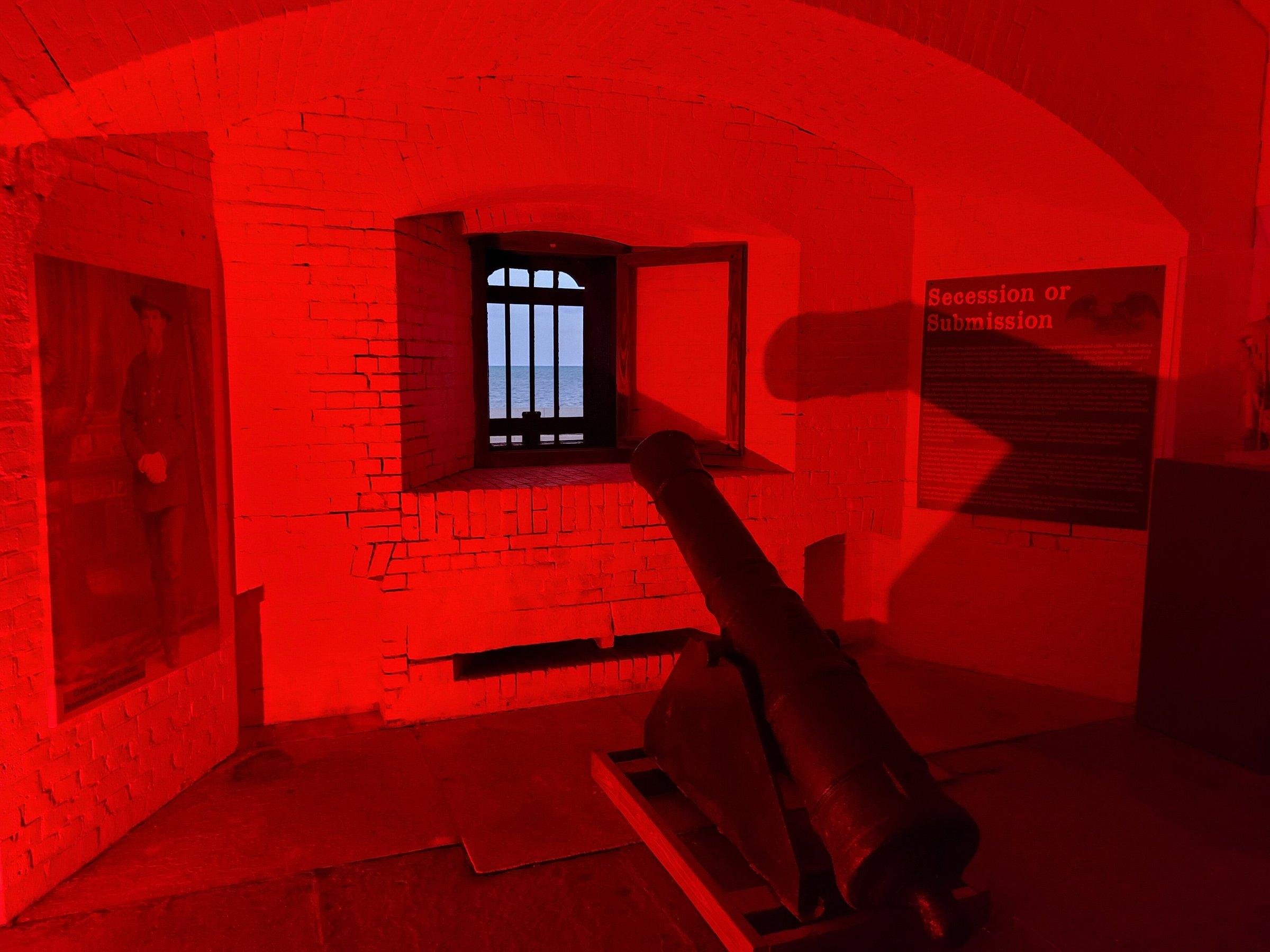
Robert is at the Fort East Martello Museum, 3501 South Roosevelt Boulevard, run by the Key West Art & Historical Society. He is included in general museum admission — there is no separate Robert ticket — and the fort also holds Key West history and art galleries that are well worth the visit on their own. Check the museum's own site for current hours and prices rather than trusting a figure printed anywhere else, including here.
If you want the doll after dark rather than in the afternoon, a separate ticketed evening at the fort runs a guided walk through the citadel followed by a seated half-hour in the room with him.
And to repeat the thing people most often get wrong: the Artist House at 534 Eaton Street is a working guest house, and Robert is not there.
- DocumentedMuseum, address, operator, and that Robert is covered by general admission rather than a separate ticket.
Sources
- Key West Art & Historical Society — Robert the Doll exhibit
- robertthedoll.org — the museum's official Robert site
- robertthedoll.org — letters to Robert
- Atlas Obscura — The Story Behind Robert the Doll
- Key West Art & Historical Society — Fort East Martello Museum
- The Artist House — house history
- Wikipedia — Robert (doll)
- Wikipedia — Child's Play (1988), development history
Where to see him after dark
The daytime museum visit and the evening tour are genuinely different experiences. In daylight you get the galleries, the fort and as long as you like in front of the case. After dark you get a guided walk through the citadel, a seated half-hour in the room with Robert, and the option of staying on afterwards with the fort largely to yourself.
Robert is one address among many. The rest of the island's haunted places are covered in our guide to haunted Key West.
Meet him properly
A guided walk through the fort, then half an hour seated in the room with him.